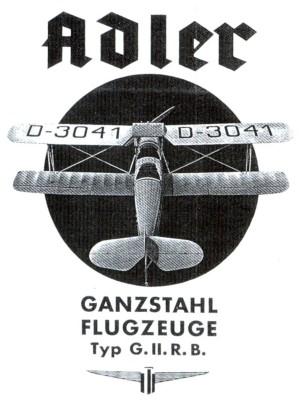
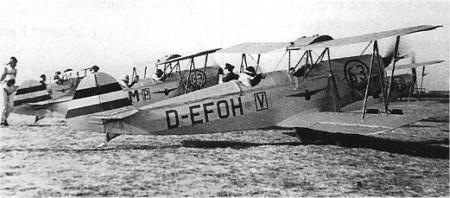
The Frankfurter Flugzeugbau Max Gerner GmbH was taken over by the Adler-Weke AG 1/1 1934. A special branch , the Adler Flugzugbau, was created. Josef Jacobs was appointed manager working together with Hans Gustav Röhr, the Technical Manager of the Adler-Werke. Jacobs was an ace from WW 1 with 41 kills and had the Pour-le-merite. Together with Ing. Walter Schilo, former head of Siemens & Halske Werksflugerprobung (Testing departmen of aircraft engines). The serie production of the Gerner light plane as Type G IIRb was started at once. Already at the Deutschlandsflug in June 1934 14 G IIRb took part.
Because of a crash, the 2 pilots were killed, an investigation was started by the RLM. This led to a stop of all flying with this type. A total rebuilt was neccesary, swept backward wings - larger rudder, ailerons, elevator - new structural calculations to achieve a higher flying weight. The new type was named G IIRc. Was accepted early 1935 but only a few were built. The Adler could not compete with the new modern designs. The Gerner company was by itself again from early 1935. Totally was 31 aircraft built.
From Wikipedia
Die Adlerwerke übernehmen Max Gerner
Die ebenfalls in Frankfurt ansässige Firma Adler, vormals Heinrich Kleyer AG, die nicht nur mit ihren Fahrrädern und Nähmaschinen, sondern vor allem mit ihren Kraftfahrzeugen Adler Trumpf und Trumpf Junior erfolgreich war, trachtete danach, wie viele andere Firmen in Deutschland ebenfalls, sich auf dem aussichtsreichen Gebiet der Luftfahrt ein weiteres Standbein zu schaffen. In diesem Feld war die Firma bereits seit 1909 tätig gewesen. Förderlich für dieses Streben war sicher die Tatsache, dass mit Franz Röhr als Chefkonstrukteur und dem Pour-le-mérite-Träger Josef Jacobs als Direktor zwei Kriegsflieger bei Adler großen Einfluss hatten und die Übernahme von Gerners Firma in die Wege leiteten. Jacobs wurde nun Leiter des Gesamtbereichs Flugzeugbau, während Gerner, nun fest bei Adler angestellt, weiter für seine Flugzeuge zuständig blieb. Durch Jacobs Bemühungen nahm der Verkauf von Gerner-Flugzeugen bald erheblich zu. In dieser Zeit erfuhr die G II Rb einige wesentliche Veränderungen. Nicht nur die Form der Leitwerke änderte sich, weg von der bisher rechteckigen Grundform hin zur Trapezform, sondern auch das Fahrwerk wurde wesentlich verbessert, durch langhubige Faudi-Federbeine, die sich nun am Obergurt des Rumpfes abstützten. Dadurch vergrößerte sich die Spurweite von bisher nur 1,2 m auf jetzt 1,6 m. Dazu kamen die moderneren Niederdruckräder. Die Gerner-Flugzeuge waren somit scheinbar auf einem guten Weg.
Nachdem bereits am 10. März 1933 eine G II R, die Wnr. 7, D-2293, trudelnd aus etwa 60 m Höhe abgestürzt und ein zweites Flugzeug, D-2833 (vermutlich Wnr. 14), unter ähnlichen Umständen am 22. Februar 1934 verunglückt war, ließ der bereits erwähnte Absturz zu Beginn des Deutschlandfluges das Reichsluftfahrtministerium (RLM) aufmerksam werden. Alle Flugzeuge des Musters wurden mit Wirkung vom 1. Juli 1934 gesperrt und eine Untersuchung angeordnet, an der auch die E-Stelle Rechlin beteiligt wurde. Als wesentliche Ursachen stellten sich einmal Störungen der Luftströmung hinter dem im Oberflügel sitzenden Tank heraus, wodurch beim Überziehen praktisch das ganze Leitwerk seine Wirkung verlor und das Flugzeug über einen Flügel abschmierte. Weiter kam eine zu große Schwanzlastigkeit hinzu. Diese Ergebnisse zwangen zu einer sofortigen Umkonstruktion, die zu einem, zumindest in der äußeren Erscheinung, stark veränderten Flugzeug führte, das jetzt als G II Rc bezeichnet wurde. Neu daran war nicht nun die Rückpfeilung der Tragflächen um 8° zur Behebung des Schwerpunktsproblems, sondern auch wesentliche aerodynamisch Verbesserungen, z. B. durch Vergrößerung des Leitwerks. Zwar erhielt das erste Flugzeug dieser Ausführung erst im April 1935 seine Zulassung, doch muss die Fertigung dieser Ausführung (oder die Änderung bereits vorhandener Flugzeuge) schon vorher eingesetzt haben, weil sonst nicht schon einen Monat später fünf, jetzt als Adler-Stahlflugzeuge bezeichnete Gerner-Maschinen am Deutschlandflug 1935 hätten teilnehmen können.
Weil das wirtschaftliche Ergebnis auf dem Flugzeuggebiet offensichtlich hinter den Erwartungen der Geschäftsführung der Adlerwerke zurückblieb und die weiteren Aussichten wegen der Abstürze und der daraufhin verhängten Sperre getrübt waren, erklärte Adler nach längeren Verhandlungen zum 30. April 1935 die Trennung von Gerner. Dieser arbeitete offensichtlich weiter, nun wieder in eigener Verantwortung als Einzelfirma, konnte aber anscheinend immer weniger Flugzeuge absetzen. Insgesamt dürften nur wenig mehr als fünfzig Flugzeuge gebaut worden sein, von denen sechs Stück G II waren, 34 G II Rb und nur noch 13 G II Rc. Wann die letzte Gerner aus dem Verkehr gezogen wurde, ist nicht bekannt.