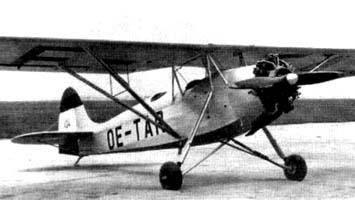
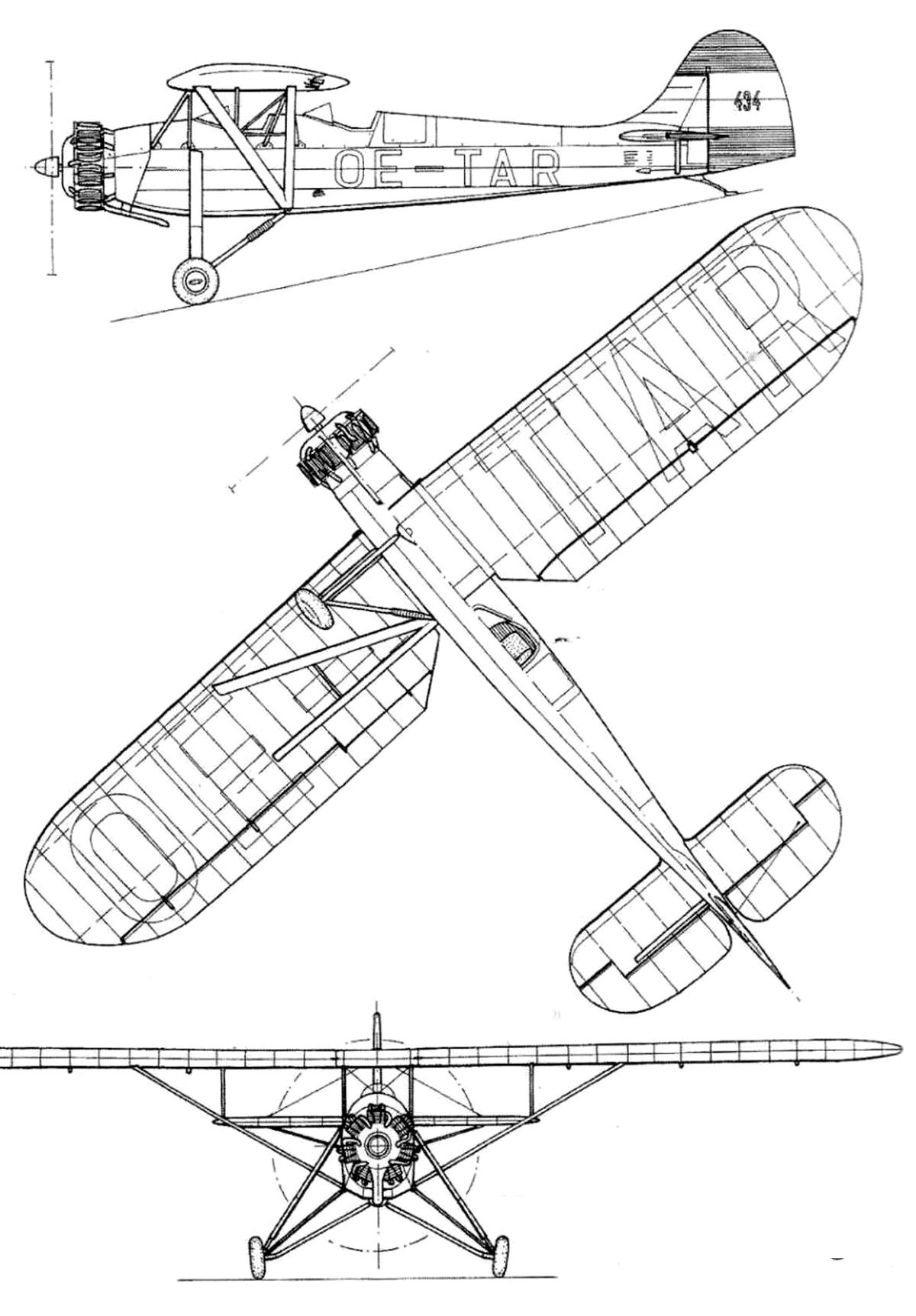
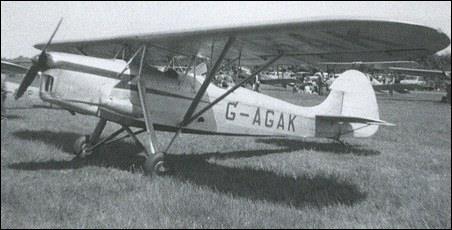
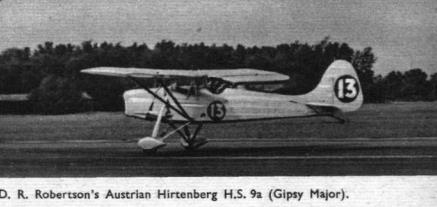
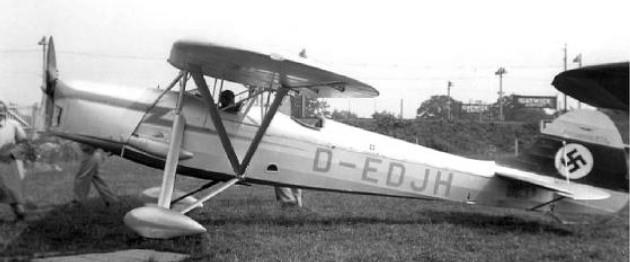
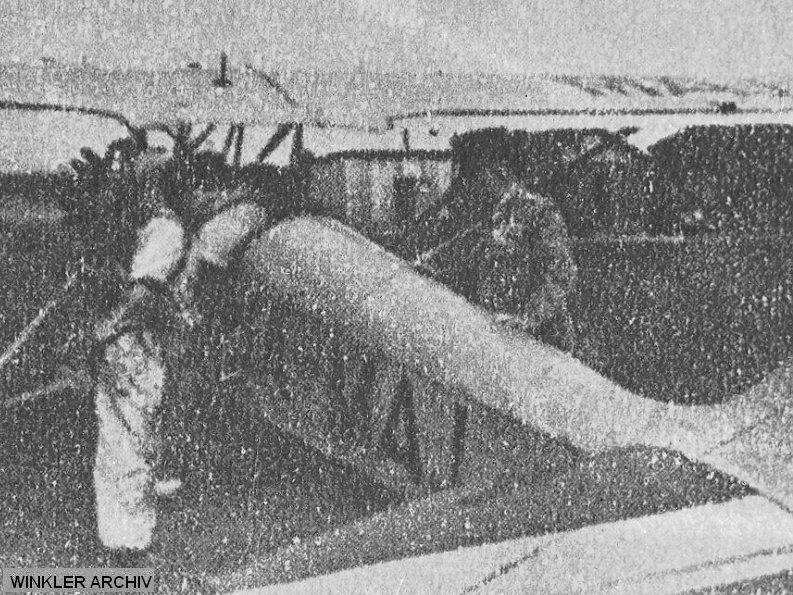
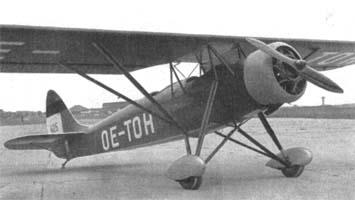
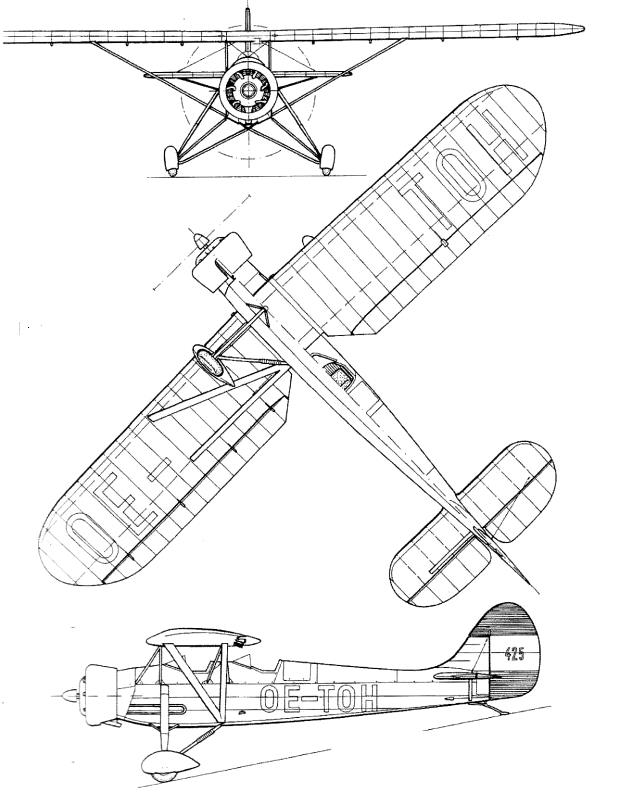
The Hirtenberg HS.9 was an Austrian two-seat touring or training aircraft of the late 1920s and early 1930s. A derivative of the Hopfner HS-5/28 via the Hopfner HS-8/29, it was a parasol wing monoplane with a fixed tailskid landing gear and room for two occupants in tandem open cockpits, and first flew as the Hopfner HS-9/32 in 1932, powered by a de Havilland Gipsy I engine. Production versions had Siemens Sh 14 engines with NACA cowlings.
Schul- und Spottflugzeug „Hirtenberg HS 9".
Dieses nunmeht von det Hirtenbetget Patronenfabrik A.-G., Abteilung Flugzeugbau, in Setie hergestellte Flugzeugmustet ist eine insbesondere auf Kunstflugtauglichkeit
abgestellte Weiterentwicklung des bekannten Hopfner-Sportflugzeuges, ein abgestrebter Hochdecker in Gemischtbauweise, serienmäßig, mit einem 150-PS-
Siemensmotor SH 14 A ausgerüstet. Die bewährten Baugrundsätze der Vorgängertype wurden beibehalten und allen mit dieser wahrend einer mehr als zehnjährigen
Erprobung im zivilen und militärischen Schulbetrieb gemachten Erfahrungen Rechnung getragen. Bausicherheit, Flugeigenschaften und Flugleistungen wurden
weitgehend verbessert.
Bei guter Geschwindigkeitsleistung und Wendigkeit zeichnet sich
das Baumuster vor allem durch seine harmlosen Flugeigenschaften, insbesonders im überzogenen Zustand und im Slip aus. Große Stabilität auch im Langsamflug, keine
Neigung, unbeabsichtigt zu trudeln oder über den Flügel abzurutschen. Ins Trudeln ist das Flugzeug nur mit groben Steuerausschlägen zu bringen. Es trudelt jedoch nach
beiden Richtungen vorzüglich und beendet diese Bewegung sofort nach Normal Stellung des Knüppels, ohne daß ein Gegensteuern mit dem Seitenruder erforderlich wäre.
Auch alle andern Kunstflugfiguren können leicht ausgeführt werden. Steuerkräfte niedrig, Ruderwirkungen, gut aufeinander abgestimmt. Sitze geräumig und bequem,
ausgezeichnete Sicht, können mit dem Fallschirm rasch und sicher verlassen werden. Das Flugzeugmuster ist für Kuristflug in der Gruppe S4K mit einem Fluggewicht von
810 kg (Zuladung 240 kg) und für Reiseflug in der Gruppe R3 mit einem Fluggewicht von 900 kg (Zuladung 330 kg) zu verwenden.
Aus betriebstechnischen Gründen wurden betriebstüchtige Serien-motoren inländischer Herkunft gev/ählt und alle häufig beanspruchten Teile, wie Fahrwerk, Sporn,
Steuerwerk, Ruderlager usf., derart bemessen, daß sie den Dauer- und Spitzenbeanspruchungen selbst eines forcierten Schulbetriebes standhalten. Durch die leichte
Klappbarkeit des Tragwerks - sie ist ohne Werkzeuge innerhalb zwei Min. durchzuführen - v/ird nur geringer Unterstell räum (8X3,5X3 m) benötigt. Bei Außenlandungen
kann das geklappte Flugzeug ohne Demontagearbeiten auf jedem, wenigstens 3,5 m breitem, Wege abgeschleppt werden. Bei Notlandungen schützt ein v/eich federndes
Fahrgestell mit hoher Energie Vernichtungsfähigkeit die Zelle, starke Dämpfung in den Oel-Luftfederstreben verhindert das Springen der Maschine und gut bremsbare
Räder erhöhen die Landesicherheit.
Harmlose Flugeigenschaften, Einfachheit der Steuerung und niedrige Landegeschwindigkeit machen es auch dem fliegerisch weniger Befähigten leicht, mit diesem
Flugzeugmuster das Fliegen zu erlernen.
Flügel stoffbespannt., rechteckige, an den Enden abgerundete Umrißform und leichte Pfeil- und V-Form. Holzbauweise mit Innen-verspannung, unterteiltem. V-Stiel aus
Profil Stahlrohr gegen den Rumpfuntergurt abgestützt. Flügel um Stielanschluß und hinteren Holmanschluß am Baldachin nach rückwärts klappbar. Vorderholm v/ird durch
einen doppeltgesicherten Bolzenschnellverschluß mit dem Baldachin verbunden. Holmgurte lameliiert, Rippen teils Fachwerk, teils Stegrippen. Anschlußbeschläge
Chrom-Molybdänblech, Innen-verspannung Stahlkabel und Stahlrohre. Die v/egen der Klappbarkeit durchlaufenden Querruder sind als Spaltquerruder mit
aerodynamischem Innenausgleich ausgebildet und maßenausgegliehen.
Rumpf: geschweißtes Fahrv/erk ohne Drahtauskreuzung, Stoff-bespannung, Rücken mit leicht abnehmbarer Leichtmetall haut verkleidet. Kräftiger, bruchsicherer
Baldachin, mit Profildrähten verspannt. Durch Bügel und Flatterleisten wird eine aerodynamisch günstige Außenform erreicht. Stoffbespannte Stahl rohrrahmensitze,
geräumig, mit v/eichen Lederkissen und Rückenpolstern. Mitnahme sov/ohl von Sitz- v/ie von Rückenfallschirmen möglich. Zum Fluggastsitz führt eine bequeme,
verriegelbare Einsteigtüre.
In beiden Sitzen Knüppelsteuer und verstellbare Seitenruderscheite. Alle Bauglieder Stahlrohr. Höhenruder wird durch Stoßstangen betätigt. Steuerzüge zu Seitenruder
und Querruder über Kugellagerseilrollen geführt. Im Führersitz Steuerdruckregler.
Vor jedem Sitz befindet sich ein elastisch gelagertes Gerätebrett, in dem die Flug-, Ortungs- und Trieb werk sinstrumente übersichtlich angeordnet sind.
Leitwerk: Zv/eiholmige. in Holz gebaute Höhenflosse, abgestrebt und verspannt, am Boden einstellbar. Stahlrohr-Höhenruder mit Seitenausgleich. Kielflosse Stahlrohr,
mit dem Rumpf organisch verbunden. Seitenruder Stahlrohr, mit Seitenausgleich.
Breitspur-Fahrwerk, geteilt, besteht aus kräftigen, an einem 4-Bock kardanisch angeschlossenen Stahlachsen und gegen die Rumpfobergurte abgestützten Oel-
Luftfederstreben. Dunlop-Niederdruckräder 4,75X7,5, Bendix-Bremsen, durch Fußpedale, auch einzeln zu betätigen. Sporn außerhalb des Rumpfes liegend, gelenkig
gelagerte Blattfederbatterie und schwenkbarer Schleifteller mit Percitauflage.
Zum Einbau kommt serienmäßig der normal verdichtete Siemens SH 14 A-Motor von 150 PS Höchst- und 130 PS Dauerleistung. Holzluftschraube von 2,3 m Durchmesser
und 1,2 m Steigung. Gashebel an der linken Bordwand, Uebertragung durch Gestänge. Die Vorzündung v/ird selbsttätig durch einen beim Gasgeben mitgeschleppten
Bosch-VorzündSchalter bev/irkt. Zum Anlassen Abschnappmagnet, ein Handkurbelmagnet sowie Außenbordpreßluftanschluß. Aluminiumgeschweißter Kraftstoffbehälter
(132 1) am Baldachin elastisch befestigt. Kraft-stofförderung durch motorgetriebene doppelwirkende DBU-Pumpe. Leitungsnetz durchwegs Aviotubschläuche mit
eloxierten Leichtmetallanschlüssen. Vor dem Vergaser reichlich bemessener Kraftstoffreiniger. Schmierstoffbehälter (16 1) oberhalb der Oelpumpe am Motorvorbau befestigt.
Spannweite 11 m, Lange 8 m, Höhe 2,4 m, Tragfläche 18 m2, Rüstgev/icht 570 kg, Zuladung 330 kg für Reiseflug und 240 kg für Kunstflug, Fluggewicht 900 kg für
Reiseflug und 810 kg für Kunstflug, Höchstgeschwindigkeit 190 km/h, Reisegeschv/indigkeit 165 km/h, Landegeschwindigkeit 70 km/h, Dienstgipfelhöhe 4400 m, Steigzeit auf 1000 m 4,5 Min., Flugv/eite 580 km.
| Type |
2-seat touring and trainer aircraft |
| Engine |
1 Siemens Sh 14A |
1 De Havilland Gipsy Major |
| Dimensions |
Length 8,02 m , height 2,39 m , span 10,96 m , wing area 18,00 m2 , |
| Weights |
Empty 569 kg, loaded 860 kg |
| Performance |
Max.. speed 190 km/h , cruising speed 170 km/h, range 400 km, service ceiling 4400 m |
| Type |
Werk.Nr |
Registration |
History |
| HS 9/36 |
1 |
OE-TAR, 434, D-EKGS, I.286, HA-MAJ |
Aircraft taken over by the N.S. Fliegerkorps Gruppe 17 (Landesgruppe Österreich). Sold to Hungary, withdrawn 1944 |
| HS 9/32, HS 9A |
|
A-144, OE-DJH, D-EDJH, G-AGAK |
Registered in UK 20/11 1939. Unregistered 1958 |
| HS 9/32 |
|
OE-DHF, D-EDHF |
|
|
30 |
425, OE-TOH |
After "Anschluss" used by the NSFK |
|
32 |
426, OE-TUH |
After "Anschluss" used by the NSFK |
|
33 |
427, OE-TAO |
After "Anschluss" used by the NSFK |
|
35 |
428, OE-TEO |
After "Anschluss" used by the NSFK |
| HS 9 |
|
OE-SPB, D-ESPB |
|
| HS 9 |
|
RU+AG |
|