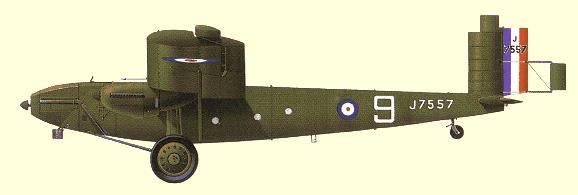
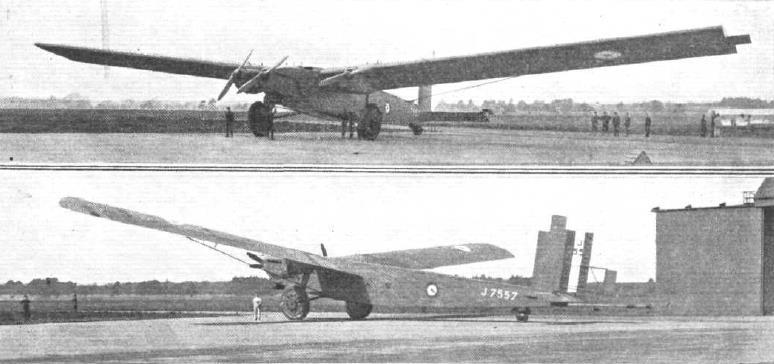
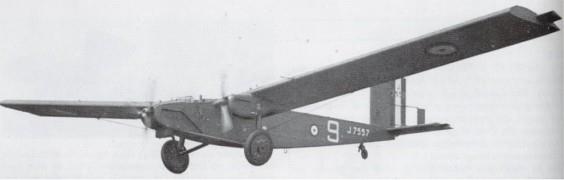
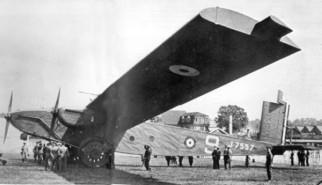
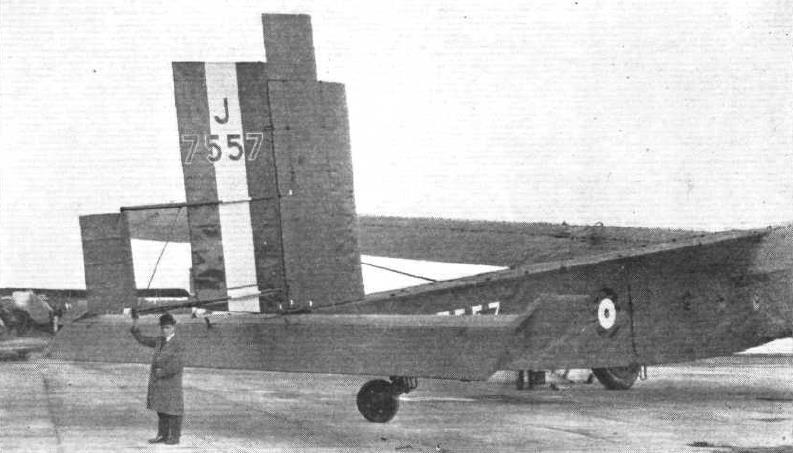
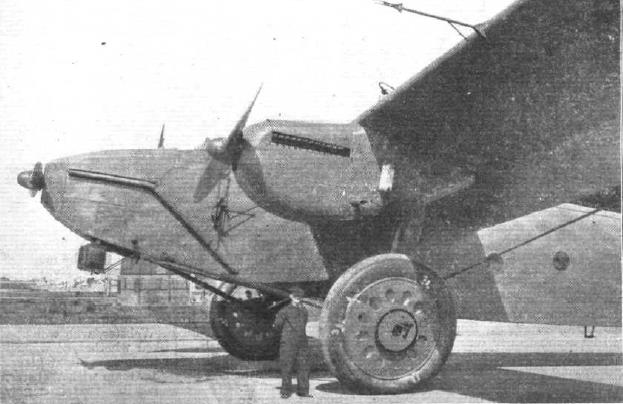
William Beardmore and Company had acquired a licence for the use of the Rohrbach principle for stressed-skin construction. Using these principles and drawings supplied by Rohrbach for the RoVI, the Beardmore company designed, what was then a massive all-metal three-engined transport, the Beardmore Inflexible.
The aircraft (Serial Number J7557) was built at Dalmuir between 1925 and 1927 and was delivered by road to the Aeroplane & Armament Experimental Establishment (A&AEE) at Martlesham Heath Airfield where it first flew on 5 March 1928,[2] appearing at the Hendon RAF Display later in the year. The aircraft was structurally advanced for its time and had good flying qualities. It was also a very large aircraft for the time, having a wingspan around 16 feet (4.9 m) greater than the Boeing B-29 Superfortress heavy bomber of World War II. However, it suffered from being underpowered and, with no interest in production, the aircraft was dismantled at Martlesham Heath in 1930. It was then used to investigate the effects of corrosion on light-alloy stressed skin structures
From the Aviastar Site
"My father was an engine fitter on the Inflexible (fresh out of RAF apprentice school Halton) and had this to say about this aircraft:
“ Powered by 3 Rolls Royce Condor’s and with a wingspan of 158 ft it was the biggest aircraft of it’s day. However the “Boffins” and “Know-alls” of the time decided that it would never fly and if it did the wings would fold up. Therefore before being allowed to make the attempt it had to be fitted with support cables from the wing roots to nearly the wingtips. I have a photograph of the Inflexible where these can just be seen. They also decided that it would need more than the length of the existing airfield at Martlesham Heath to take off. With this in mind an extra 400 yards of heath was cleared for the initial flight. Most of the population of Ipswich and the surrounding villages turned out to watch the event. As it happened the extra 400 yards was not nearly needed and the Inflexible took off well before the end of the existing runway, no strain was evident on the cables and according to those on board, the flight was uneventful and the aircraft flew well. It was never allowed to fly without the cables, which completely ruined any chance of the Inflexible being termed a proper cantilever wing. The cables were as thick as those used to moor ships”.
BEARDMORE " INFLEXIBLE " Three Rolls-Royce Condor M Engines"
It is an undoubted fact that size as such exerts a peculiar fascination on the majority of people. Wc experience it in nature, in buildings, in ships, and in aircraft. The magnitude of mountain and ocean, the towering of the skyscraper, the colossal bulk of the ocean liner, all have an appeal which can be traced back to size. Even in aircraft we do not escape it. We may have our doubts as to the efficiency of a very large aeroplane, but in spite of ourselves we are impressed. Probably without putting the thought into definite form we are impressed by the feat of getting so many tons of inert matter into the air. And in the earlier days of aviation it was quite a common view that if one only built a machine large enough, it could fly across the Atlantic. (We are writing now. of course, of the days when the possibility of doing so was rather remote.) How that view came to gain ground is not very easy to imagine, except that the appeal of size was in all probability at work. A fundamental law, which we cannot escape, decrees that if we take any small aeroplane and build an enlarged version of it. geometrically similar in every way, the area of the large machine will vary as the square of a linear dimension, while the weight will vary as the cube. Thus fundamentally the large aeroplane is fighting against a natural limitation.
No aircraft designer denies this law, but there are those who maintain that, as we do not make our large machine geometrically similar to the smaller one, the law does not apply. Thus it is claimed that by making refinements in the details of the construction, refinements which become possible in the large machine but were out of the question in the smaller one, sizes far beyond those indicated by the plain W3/2 law become practicable. In the Beardmore Inflexible, a large monoplane of Rohrbach design, constructed at the Dalmuir works of Wm. Heardmore and Co., wo have an interesting attempt at " beating the W3/2 law." The Beardmore "Inflexible" is, as the accompanying illustrations show, a monoplane of very large span (about 158 ft.), and equipped with three Rolls-Royce "Condor" engines. The machine is of all-metal construction, including the skin of wings and fuselage, which is of Duralumin. Steel is used for a few highly-stressed fittings, but for the rest the entire machine is built of Duralumin.
The general principles of construction are those adopted by Dr. Rohrbach for a number of years, and include the use of a form of metal " box to form the wing spars, the sheet-metal covering being laminated and the number of laminations depending upon the stresses at any particular point.
At present no information concerning the performance of the machine is available. The " Inflexible " is known to have been tested in flight at Martlesham, and is reported to have flown very well and to be very controllable. Features of the design visible in the photographs are the large span, the balanced control surfaces, and the I'lcttner type servo-rudder. The large Dunlop wheels must have presented a pretty problem in design, having to carry a load of something like 7,5 tons each.
We had occasion to refer recently to the alleged characteristics of a large machine designed by Herr Dornier. and expressed the view that, with the weight and dimensions given, the machine would be unable to get off. In the case of the Beardmore " Inflexible " it can easily be shown that the induced drag of the wing has been reduced to quite a low figure. The span is approximately 158 ft., and the loaded weight is given as in the neighbourhood of 15 tons.
Assuming these figures to be approximately correct, the value of Span² /W is 0,74, which is very much higher than is usually found in large aeroplanes. In fact, a value of 0-3 is not uncommon. As the power loading is round about 16 Ibs./h.p., there is no reason whatever why the "Inflexible" should 'not have quite a good performance. Its great size has, not unnaturally, given the wags an opportunity to exercise their wit, and the machine has been variously nicknamed the " Incredible," the " Impossible " and the " Brittle." The last name presumably comes from an assumption that anything which is inflexible must be brittle.
It is to be hoped that detail information may soon become available as the machine is a most interesting experiment. Apart from performance figures, it will be particularly interesting to learn what percentage of tare weight to gross weight has been attained. We gather that the useful load is a good deal greater than most people would imagine.
| Type |
Night bomber |
| Engine |
3 Rolls-Royce Condor IIIa with 2-bladed wooden propellers |
| Dimensions |
Length 22.9 m, span 47.9 m, wingarea 182.8 m2, aspect ratio 12.6 |
| Weights |
Empty 11022 kg, load 5758 kg, flying weight 16780 kg |
| Performance |
Max. speed 180 km/h at sea level, cruising speed 160 km/h, landing speed 102 km/h, climb 12 min. to 1000 m, service ceiling 3800 m, range 1600 km |
| Type |
Werk.Nr |
Registration |
History |
|
|
J 7557 |
Built by William Beardmore & Co, drawings provide from Rohrbach. First flight 5th of March 1928. After testing it was dismantled in 1930. .This aircraft was built purely for research. It was built by Beardmore at Dalmuir under great secrecy. In the air it was described as a pilot's aeroplane. In the company records it's referred to as the BERO BE for Beardmore and RO for Rohrbach. The pilots were Noakes and De Haga Haig and both were ordered never to do aerobatics in public. It was so strong that you could see the fuselage wrinkle and the young airmen used to run along the wings and fuselage. When testing was completed the fuselage was broken for paint tests, were used for corrosion tests then it disappeared by 1933. It had the biggest wheels in a pre war aircraft. |