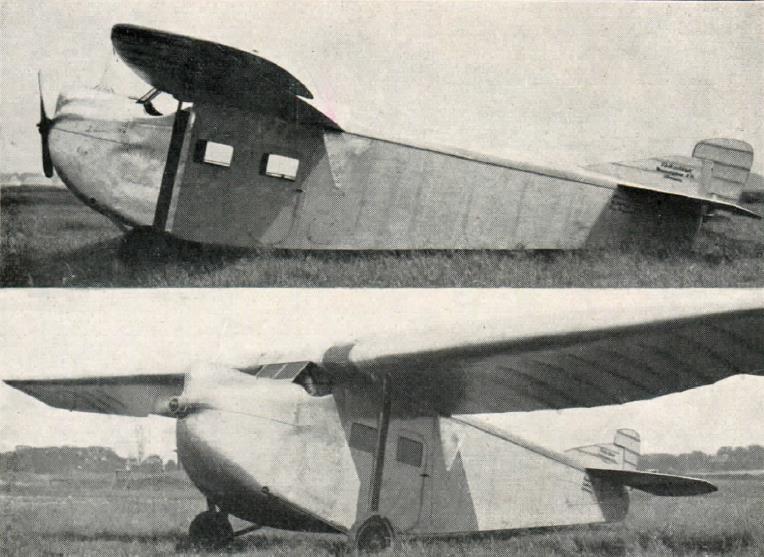
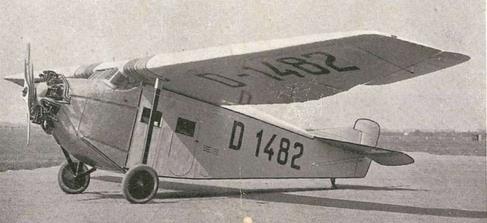
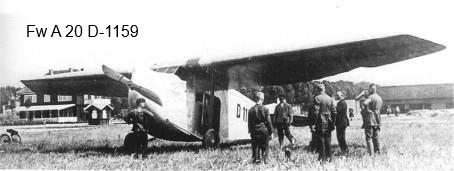
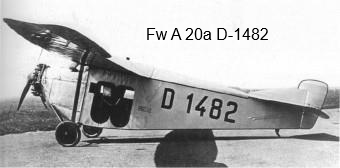
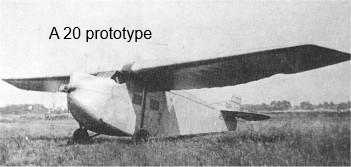
The Focke-Wulf A 20 Habicht (German: "Hawk") was an airliner developed in Germany in the late 1920s. It was a high-wing cantilever monoplane with fixed tailskid undercarriage. The fuselage was deep and seated four passengers in a fully enclosed cabin. The type was not bought by the airlines and only a few examples were built.
The Focke Wulf " Habicht "
In addition to the larger " Moewe " described last week, the Foc.ke Wulf firm exhibit a small " feeder line " type of machine, the " Habicht " (Hawk), with Wright " Whirlwind " engine. The works series designation of this machine is A.20A, the " Habicht " being known, when fitted with a 120 Mercedes-Benz engine, as the type A.20, and as the A.28 when the power plant is the Bristol " Titan " engine. In either case the machine is of typical Focke-Wulf design : a cantilever monoplane with a wing of " Zanonia leaf " plan form, which is claimed to improve lateral stability, even at angles past the stall.
The cantilever monoplane wing is built entirely of wood, a large box-section spar forming the main structure, but the leading edge also being planked with ply-wood. The whole is afterwards covered with fabric. The fuselage has plywood covering over the cabin portion, and the forward part, engine mounting and pilot's cockpit, is aluminium covered.
The small cabin has four seats, and as the machine is very low on the ground, entrance is direct through the door in the port side, without the use of steps. The pilot sits ahead of the wine:, partly under the leading edge
The undercarriage is similar to that of the " Moewe," i.e., with axles and radius rods hinged to the lower longerons and vertical struts to the leading edge of the wing, inside which are the rubber cords which absorb the landing shocks.
The Wright " Whirlwind " engine is mounted in the nose, with the two petrol tanks housed, one on each side, inside the leading edge of the wing, giving direct gravity feed to the carburettor.
The main dimensions of the " Habicht " are : Length o.a., 10-2 m. (33-5 ft.) ; wing span, 16 m. (52-5 ft.) ; wing area, 32 sq. m. (344 sq. ft.). The tare weight of the machine is 1,000 kg. (2,200 lbs.) ; permissible load, 600 kg. (1,320 lbs.) ; total loaded weight, 1,600 kg. (3,520 lbs.). Maximum speed, 170 km./h. (105 m.p.h.) ; cruising speed, 150 km./h. (93 m.p.h.) ; landing speed, 80 km. h. (50 m.p.h.). Climb to 1,000 in, (3,280 ft.) in 5-4 mins. Ceiling 5,500 m, (18,000 ft.). Range, 650 km. (400 miles').
Flight Febr. 1930
Stopping the Spin without Slots
THE general press at home, and in Germany, has been much impressed by a recent demonstration of " non-spinning qualities on the part of a Focke-Wulf commercial monoplane, the " Habicht " (Hawk). This machine, or one like it, was exhibited on the Focke-Wulf stand at the Berlin Aero Show in 1928, and is a " feeder line " type of machine with (in the exhibition machine) a Wright " Whirlwind " engine. At the recent demonstration over the Tempelhof aerodrome, Berlin, the machine was flown stalled on several occasions, and showed no signs of dropping into a spin. No " gadgets " of any sort are fitted, the stability being obtained solely by the shape of the wing and, one suspects, by a judicious forward placing of the e.g. The plan form of the Focke-Wulf machines has, in all types, been based largely on the Zanonia plant's winged seeds, much as were the early Taube monoplanes. In the Focke-Wulf monoplanes, however, the projecting, upward-turned flaps are much less pronounced, but apparently much of the lateral stability is still maintained. As the Focke-Wulf monoplanes have also been known for their good aerodynamic efficiency, it may be assumed that tiie stability is obtained without sacrificing other good qualities
| Type |
A20 1 + 4 seat airliner |
A20a 1 + 4 seat airliner |
| Engine |
1 Daimler DIIa |
1 Wright Whirlwind |
| Dimensions |
Length 10.02 m, span 16.0 m |
|
| Weights |
Empty 988 kg, flying weight 1425 kg |
Empty 1000 kg, flying weight 1600 kg
|
| Performance |
Max. speed 145 km/h |
Max. speed 170 km/h |
| Type |
Werk.Nr |
Registration |
History |
| A 20 |
34 |
D-1159, D-OFOR |
In Febr. 1928 delivered to Schwäbisch-Bayerischen Fluggesellschaft, in May to Nordbayerischen Verkehrsflug and in April 1932 sold to Fliegerschule Dittmar |
| A 20a |
52 |
D-1482 |
In Aug. 1928 registered to FW AG, sold abroad in Aug. 1930 |
| A 20 |
53 |
D-1439 |
In July 1928 to Luftverkehrs-Gesellschaft mbH at Wilhelmshafen-Rüstringen. Probably scrapped 1935 |
| A 20 |
94 |
D-1726 |
In July 1929 owned by Leonard Monheim - Trump Schokoladenfabrik, Aachen, used for PR. Maintenance was managed by the Lufthansa. From Aug. 1931owned by K. F. Roeder, Wiesbaden |
Focke-Wulf A. 20 Verkehrsflugzeug „Habicht".
Das vor mehreren Jahren von der Fockc-Wulf-Flugzeugnau A.-(i.
herausgebrachte Verkehrsflugzeug A. 16 stellte hinsichtlich seiner Ver-
kchrsükonomie bereits einen vollen Erfolg dar. Fs konnte sich in der
Zwischenzeit auf verschiedenen Verkehrslinien unter schwierigsten
Verhältnissen bewahren. Das neue Verkehrsflugzeug A. 20 stellt eine
Weiterentwicklung dieser Bauart dar, bei der vor allem der Führer-
raurri geräumiger gestaltet wurde, um den Piloten auch bei längeren
Flügen bessere Bequemlichkeit zu bieten. Oer Führersitz ist daher
nicht mehr neben, sondern hinter dem Motor angeordnet, durch einen
Brandspant aus Stahlblech getrennt. Um den Piloten auch bei Ueber-
schlägen zu sichern, ist der Raum derart unter den Flügeln gefegt, dal'»
der Kopf des Piloten in einer Aushöhlung des Tragflügels zu liefen
kommt. Der Raum wird durch die Kabine bestiegen und nach vorn
durch eine Scheibe aus splittersicherem Triplexglas abgedeckt. — Die
Brennstoffbehälter sind so untergebracht, daß eine Beeinflussung der
Trimmung nicht mehr stattfindet. — Der Lastraum ist in seiner gan-
zen Länge durchschnittlich 1,80 m hoch geworden. Fr ist weiter um
etwa 25 cm verlängert, so daß Sitzanordnung in Flugrichtung ermög-
licht wurde. -Das Kastenfahrgestell ist durch ein am Flügel augrei-
fendes Fahrgestell, dessen Federung in der Flügelnase liegt, ersetzt.
Die neue Bauart besitzt geringeren Widerstand bei größerer Spur-
weite. — Infolge der genannten Verbesserungen hat das Flugzeug
größeres Gewicht erhalten. Da auch die Flugleistungen verbessert
werden sollten, wurde der früher 14 m spannende Tragflügel auf 16 m
vergrößert, wobei eine Verlängerung des Rumpfes um 0,51) m nötig
wurde. — Es ist anzunehmen, daß das an sich bereits recht beliebte
Kleinverkehrsflugzeug in seiner neuen Form noch mehr Liebhaber fin-
den wird als bisher, zumal es zu den wirtschaftlichsten Verkehrsflug-
zeugen der Welt gehört.
Motor Mercedes-Benz I/ IIa 120 PS, Spannweite 16,00 m, Länge
10,20 m, Höhe 3,00 m, Tragfläche 32,00 nr, Rüstgewicht 988 kg.
ZufOllung 437 kg, Fluggewicht 1425 kg, Flächenbelastung 44,5 kg/m2
Geschwindigkeit 145 km/h, Gipfelhöhe3500 m, Steigzeit auf 1000 m 10 min..
Anlauf 170 m, Auslauf 150 in.