| Type |
2 + 8 seat airliner |
a 2 + 8 seat airliner |
b |
| Engine |
1 BMW VID |
| Dimensions |
Length 14.8 m, height 4.00 m, span 20.0 m, wing area 62.5 m2 |
| Weights |
Empty 2850 kg, flying weight 4500 kg |
| Performance |
Max. speed 200 km/h, cruising speed 176 km/h, landing speed 92 km/h, range 800 km, service ceiling 4700 m, required runway for take off 480 m |
|
|
| Type |
Werk.Nr |
Registration |
History |
| A29 |
58 |
D-1867, D-ULIP |
"Westfalen". Used by the Lufthansa from June 1930 to Sept. 1934. Later used by the DVS |
| A29 , A29b |
61 |
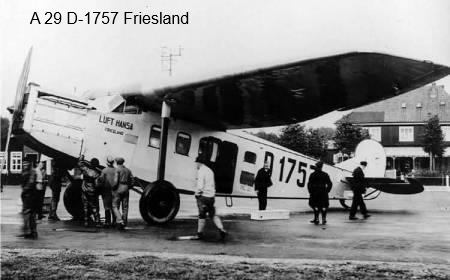
D-1757 |
"Friesland". From Oct. 1929 until Sept. 1934 used by the Lufthansa. Later used by the DVS. From May 1932 converted to b version |
| A29 |
62 |
D-1775 |
"Jeverland". From Nov. 1929 used by the Lufthansa. Crashed 13th of Aug. 1931 at Göppingen |
| A29 a |
63 |
D-1922 |
"Saarland". From July 1930 used by the Lufthansa. Crashed 28th of July at Schönwalde |
| A29 |
114 |
D-2178 |
Registered to the DVS in Nov. 1931, used as an trainer for the commercial pilots and for training the aviators in the secret military arm. |
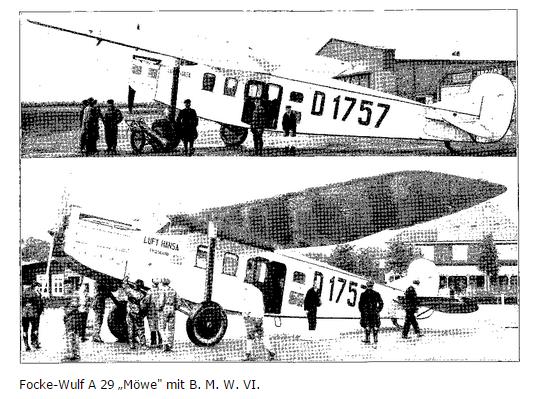
Focke-Wulf A 29 „Möwe".
Die Focke-Wulf „Möwe" Muster A 17a mit Siemens-Jupiter-Ge-triebemotor ist im deutschen und internationalen Luftverkehr der Deutschen Lufthansa A.-G. eine bekannte
Erscheinung geworden. Ihre nach dem Zeugnis der Lufthansa ausgezeichnete Streckenbewährung vorwiegend auf den langen Auslandsstrecken (z. B. Berlin—Zürich, Berlin-
Paris) und ihre guten Schlechtwetter-Flugeigenschaften haben sie bei Führern und Fluggästen schnell beliebt gemacht. Nahezu einzigartig ist bei der Focke-Wulf „Möwe" aber
ihre hohe Betriebswirtschaftlichkeit infolge der guten aerodynamischen Eigenschaften und des einfach konstruierten Aufbaues, der mäßigen Anschaffungspreis bei niedrigen
Unterhaltungs- und Reparaturkosten zur Folge hat.
Obwohl das letzte Flugzeug von den 10 Stück der Serie 1928 noch nicht ganz ein Jahr vorher der Lufthansa geliefert wurde, hatten die Focke-Wulf „Möwen" im August 1929
bereits über eine Million km zurückgelegt.
Seite 416
„FLUGSPORT'
Nr. 22
So ist es leicht verständlich, daß gerade im Hinblick auf die heute so dringende Notwendigkeit sparsamsten Arbeitens die Lufthansa weitere „Möwen" in Dienst zu stellen
wünschte, und die Focke-Wulf Flugzeugbau A.-G. einen Auftrag auf 4 weitere Maschinen erhielt.
Diesmal wurde die Ausführung mit B. M. W. VI-Motoren gewünscht, und das so entstandene Muster erhielt die Bezeichnung: A 29 „Möwe".
Bei dem schweren, wassergekühlten Motor, der Kühlanlage und ihrem Wasserinhalt sowie den zahlreichen bestehenden und neu hinzugekommenen Wünschen des praktischen
Luftverkehrs war eine erhebliche Gewichtserhöhung gegenüber dem Muster A17 a unvermeidlich, wenn nicht von dem soliden konstruktiven Aufbau etwas geopfert werden
sollte. Erste Fachleute bezweifelten, daß bei dem so entstehenden Fluggewicht von 4300 kg statt 4000 kg (gleichbleibende Zuladung vorausgesetzt) eine ausreichende
Startleistung Zustandekommen würde. Die Vorausberechnungen von Focke-Wulf sind aber nicht nur erfüllt, sondern noch weit übertroffen worden, denn die A29 „Möwe" hat
eine noch um ein Weniges bessere Startleistung (für 20 m Höhe 480 m) als die A17a (für 20 m Höhe 485 m), und zwar noch bei 4400 kg Fluggewicht. Dasselbe gilt für die
Steigleistung, die von 6,4 Min. auf 5,7 Min. für 1000 m verbessert wurde, ebenfalls mit 4400 kg. So konnte also die Zuladung von 1550 kg noch auf 1690 kg erhöht werden
(vergl. unten). Dies wurde erreicht mit B. M. W. VI-Motor (1:5,5) ohne Getriebe. In eines der Flugzeuge wird zu Vergleichszwecken ein Motor mit Getriebe eingebaut, mit
dem sich die Leistungen naturgemäß noch weiter verbessern.
Im Aeußeren unterscheidet sich die A29 von der A17a auf den ersten Blick nur durch den Motoreinbau mit Stirnkühler. Doch sind, z. T. in enger Zusammenarbeit mit der
Lufthansa, mancherlei Einzelheiten vervollkommnet Worden. So erfuhr die Windschutzscheibenanordnung des Führerraumes eine Umänderung zweck weiterer Verbesserung
der Sichtverhältnisse, ohne die aerodynamischen Rücksichten zu vernachlässigen. Die Kielflosse wurde am Boden einstellbar gemacht und die Höhenflossenverstellung
konstruktiv geändert. Ferner erhielt das Fahrgestell auf Wunsch der Lufthansa überall Kugelgelenke statt der bisherigen Kardanstücke. Man darf hiervon eine Verminderung
der Kosten für Bolzenabnutzung erwarten. Schließlich wurde die Umrißform des Höhenleitwerks in systematischen Versuchen abgeändert, um möglichst starke Ruderwirkung
beim Landen zu erzielen.
Eine interessante Variation der A 29 bzw. der A 17 a wurde von der Deutschen Versuchsanstalt für Luftfahrt bestellt. Dieses „A26" genannte Muster ist für Versuche mit
verschiedenen, und zwar luft-und wassergekühlten Motoren in der gleichen Zelle bestimmt und hat dementsprechend auswechselbare Motorvorbauten, die mitsamt den fertig
eingebauten Motoren ausgetauscht werden können. Durch jeweilige Messung der Flugleistungen kann der Einfluß der Motorleistungen und Drehzahlen des Propellers
einschließlich der durch den Motor selbst bedingten Formgebung des Rumpfvorderteils, evtl. der Kühlerdurchströmung usw., festgestellt werden.
Die Kabineneinrichtung ist fortgelassen worden, und der so verfügbare Raum dient zur Unterbringung der Instrumente und Beobachter, um die Betriebsverhältnisse der Motoren im Fluge zu studieren.
Abmessungen und Gewichte: Tragfläche 62,5 m2, Spannweite 20 m; Länge über alles 14,8 m, größte Höhe 4 m, Rüstgewicht 2710 kg, Zuladung: 2 Führer 160 kg, Betriebsstoff für 5 Std. 500 kg, Oel 50 kg,
8 Fluggäste 640 kg, Gepäck und Fracht 340 kg, zusammen 1690 kg, Fluggewicht 4400 kg.
Leistungen mit 4400 kg nach Messungen der D. V. L. bzw. D. L. H.: Höchstgeschwindigkeit 198 km/Std., Reisegeschwindigkeit bei 12 Prozent Drosselung 176 km/Std.,
Landegeschwindigkeit 92 km/Std., Steigzeiten für 1000 m 5,7 Min., 2000 m 12,6 Min., 3000 m 21,7 Min., 4000 m 36,2 Min., 4500 m 48,8 Min. Steiggeschwindigkeit in der Luftdichte 1,1 kg/m3 2,6 m/Sek., Gipfelhöhe (Steiggeschwindigkeit = 0) 4700 m, Dienstgipfelhöhe (Steiggeschwindigkeit = 0,5 m/Sek.) 4500 m, Statt: vom Stand 20 m Höhe
erreicht nach 480 m.