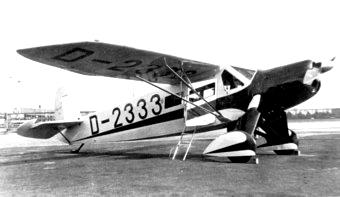
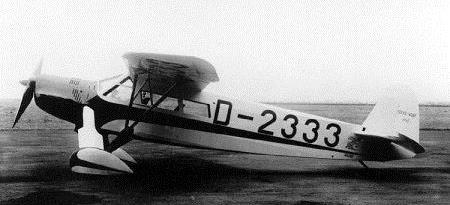
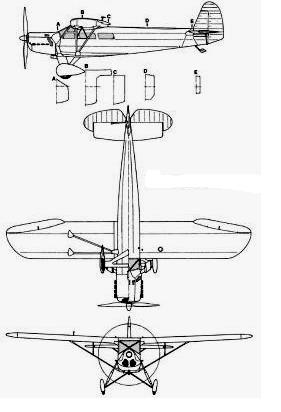
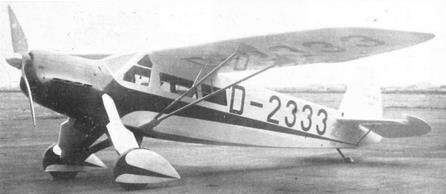
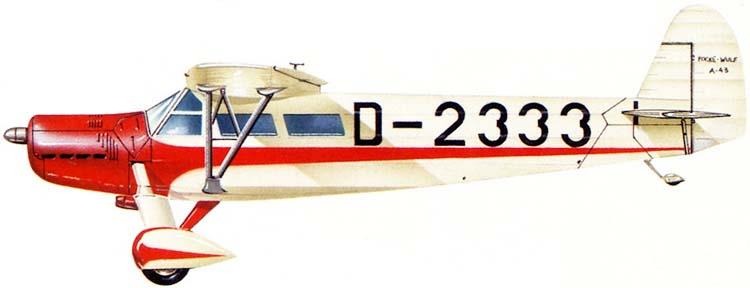
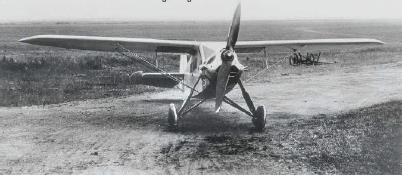
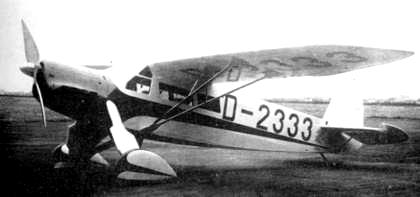
The Focke-Wulf Fw 43 Falke (German: "Falcon") - known internally to Focke-Wulf as the A 43 - was a light utility aircraft developed in Germany in 1932. it was a high-wing strut-braced monoplane of conventional design with fixed tailwheel undercarriage. The pilot and two passengers sat in a fully enclosed cabin. Only a single example was built.
Reference:
Flug- und Modelltecnnlk. Juni 1998
Lange, Bruno: Das Buch der deutschen Luftfahrttechnik, Mainz 1970
Die Luftwacht 1932
VFW-FOKKER. FLUGZEUG-MONOGRAFIE No. 5. FOCKE-WULF A43 FALKE
| Type |
1 + 2-seated fast transport |
| Engine |
1 Argus As 10 with fixed two-bladed propeller, fuel consumption at 1500 rpm 35 kg/h |
| Dimensions |
Length 8.30 m, , height 2.30 m, span 10.0 m, wingarea 14.0 m2, aspect ratio 7,14 |
| Weights |
Empty 725 kg, flying weight 1125 kg, fuel 226 l (2 tanks ) , oil 20 l, wingloading 80,3 kg/m2, powerloading 5,1 kg/hp |
| Performance |
Max. speed 255 km/h at sea level, cruising speed at economical power 240 km/h, cruising speed at 1500 rpm 215 km/h, climb 4.5 min to 1000 m, range 1050 km, service ceiling 5100 m, range at 1500 rpm 1050 km, endurance 5 ,00 h at 1500 rpm, landing speed 108 km/h, start to 20 m altitude 510 m, landing from 20 m 580 m |
| Type |
Werk.Nr |
Registration |
History |
|
127 |
D-2333, LZ-MIL
|
First flight 1932, pilot cornelius Edzard. Shown at the DELA exhibition at Berlin 1932.Used by the Norddeutschen Luftverkehrs GmbH from Aug. 1932 until 1934. Used by the RLM as liaison Aircraft. Given to the king of Bulgaria. Named "Milka". Last known 1936/37 in Sofia. |
Focke-Wulf A 43 "Falke"
The A 43, a three-seat high-speed touring and air taxi, differs from other Focke-Wulf airliners in that it is not a cantilevered but a braced high-wing monoplane. The primary construction materials are wood and steel tubing. The wings are split. Both halves are attached to the upper fuselage chords at a slight dihedral angle and braced to the lower fuselage chords by a V-strut each. The wings are rectangular, slightly rounded at the tips, and have a uniform chord. The airfoil is nearly symmetrical and angled downwards towards the wingtips. The wing stub connections to the fuselage and wings are faired, and the struts themselves are polished and chrome-plated to minimize drag. For the same reason, the joints between the fuselage and wings are also meticulously crafted.
Wing construction: two box spars (pine stringers and plywood walls) and pine truss ribs. Internal bracing is absent; instead, the wing is planked with plywood between the spars. The remaining wing sections are fabric-covered. Struts are profiled steel tubes.
The rectangular fuselage slopes down considerably at the front of the wing, tapering to a high vertical wingtip at the rear. The cabin, beginning immediately behind the engine cowling, contains three seats in tandem, the foremost of which is equipped with controls. Large windows at the front of the cabin and sliding windows made of shatterproof glass in the side walls provide good visibility. Two doors on the starboard side.
The fuselage frame is a truss of welded chrome-molybdenum steel tubing without wire bracing; welds are reinforced by webs or overlaps. The cabin is made of plywood, still fabric-covered; the fuselage frame is fabric-covered.
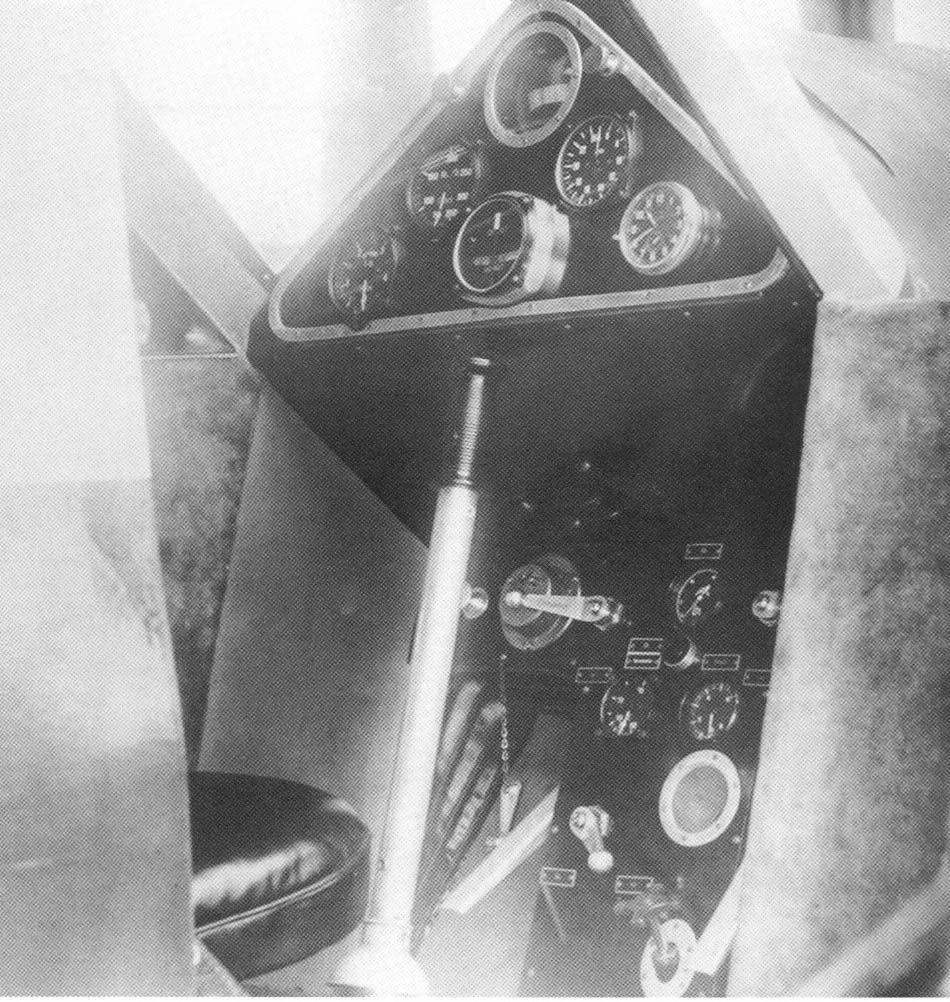
The ailerons, located at the wingtips and constructed of wood, have internal balance (pivot axis positioned behind the center of gravity); the horizontal stabilizer has a fin supported by the fuselage and adjustable in flight; the split elevator has a flap balance, as does the rudder. Except for the horizontal stabilizer, which is entirely made of wood, all parts of the tail assembly are constructed of welded steel tubes with fabric covering. All control surfaces, with ball bearings, are balanced so that, with good control response, no excessively low forces occur. The aircraft's tendency to roll and pitch can be compensated for by adjusting the stiffening of a flexible trailing edge located on the control surfaces. The control stick is mounted on a pivot with ball bearings. The rudder levers are recessed into the front bulkhead and sealed off externally by accordion-like bellows. The movement is transmitted to the elevator via pushrods, bellows, and cables. Ailerons are actuated by short pushrods attached to the yoke, each rotating a gear with a roller. The chain drive runs over several pulleys, also designed as gears, to a sprocket mounted on the aileron shaft and back to the bellcrank. Between the pulleys, the chains are replaced by steel wires. The rudder pedals act on a rotating crossbar, from which cables run to a bellcrank with a pushrod in the rear of the fuselage. Altitude adjustment is achieved by a self-locking spindle operated by a hand crank and cable.
All control levers are mounted on ball bearings. The cables and other control linkages routed through the floor are easily accessible after removing the cabin floor. Similarly, the aileron control cables can be serviced without difficulty.
The landing gear consists of two half-axles, hinged in the middle under the fuselage and supported by a strut to the underside of the fuselage and a spring strut to the fuselage sides.
Stems made of steel tubing, streamlined and faired. Suspension is provided by endless rubber rings. The wheels (Elektronmetall-Cannstatt) have hydraulic internal shoe brakes, actuated by levers inside the control pedals using pressurized oil (automatic refilling). They, like the landing gear struts, are sheathed with Elektron sheet metal. The tail skid is pivotally mounted and sprung with rubber bands. The tail shoe carries a solid rubber roller in the center, positioned so that on hard surfaces only the wheel makes contact, while on very soft surfaces the entire shoe makes contact. This design offers the advantage of easy handling of the aircraft on concrete surfaces.
The A 43 model is equipped with a 195/220 hp Argus As 10 (eight-cylinder V, inverted, air-cooled) engine. Rubber plates are positioned between the engine mount and the suspension brackets for shock and vibration damping. The firewall is designed so that the rear part of the engine casing protrudes through it, while the laterally arranged carburetors are located in recess-like bulges in front of it. All pipe and linkage penetrations through the firewall are flameproof; there is no lightweight linkage in the engine compartment.